Friday, March 11, 2011

London, Day 5

This morning we planned to go to Westminster Abbey.  On the way, whilst crossing the almost uncrossable roads that make up Parliament Square, we happened across the old Middlesex Guildhall which has been completely refurbished and is now the home of the Supreme Court, the highest court of appeal in the United Kingdom.  Established by law in 2005, it sat for the first time in October of 2009.

Supreme Court of the United Kingdom

To enter the building we passed through a level of security that was much higher than that required later in the day when we visited Westminster Abbey. Entry to the Supreme Court is free whereas Westminster Abbey has an entrance fee of sixteen pounds.  Fortunately being "oldies" we got in for thirteen pounds each.  This always raises the problem of whether we should be pleased at getting the concession or annoyed that they don't require proof of our age.  Hmph!  I guess we just look like a couple of seniors these days.

But back to the Supreme Court which represented a huge change in the legal system.  Its introduction meant that there was now a separation of powers with the Supreme Court not being the old Law Lords in the Parliament but completely separate from the Legislature.  The Supreme Court hears civil cases from England, Wales, Northern Ireland and Scotland and criminal cases from England, Wales and Northern Ireland.  The symbol of the court represents all four of the elements of the United Kingdom.
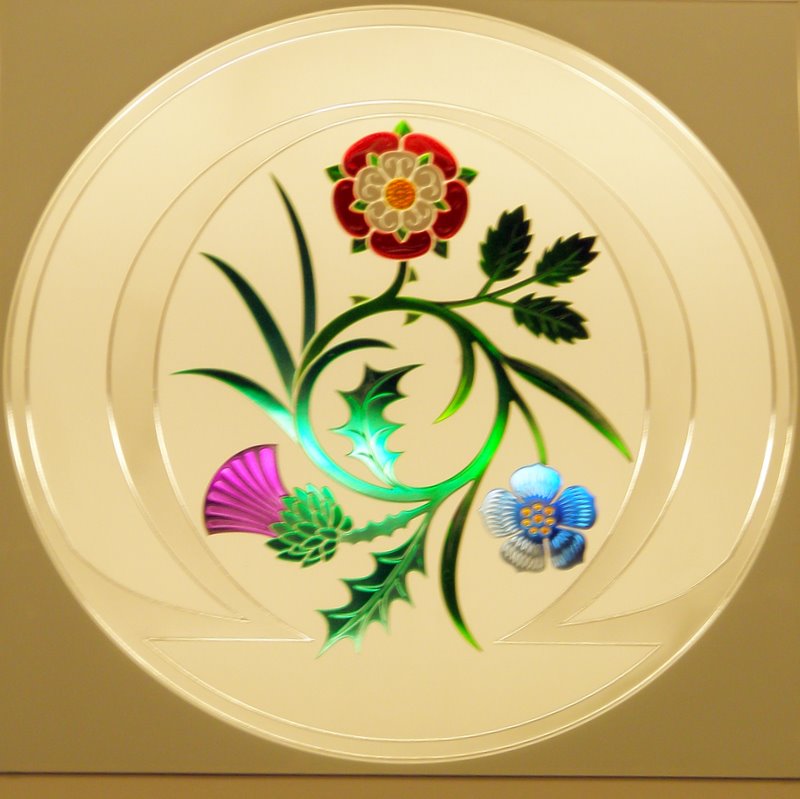
Symbol of the Supreme Court

In addition the Court sits as the Judicial Committee of the Privy Council, the highest court of appeal for the United Kingdom's overseas territories and crown dependencies and a number of  independent Commonwealth countries.

A Supreme Court Courtroom

The staff were very welcoming and acted as informal guides since we were unable to take one of the more structured tours.  The view from the upper levels of the building, over Westminster Abbey, are fantastic and as one of the staff told us although the building will be closed for business on the day of the Royal Wedding, many of those who work in the building will be there and will have just about the best seats possible for the comings and goings at the Abbey on the 29th of April.

We then went to Westminster Abbey.  It was very crowded and we wondered if there had been an increase in numbers as a result of the forthcoming wedding there. What can one say about the Abbey?  Here are buried or memorialised the great and famous including a number of Australians and Americans.  George Peabody lay in the Abbey for several years before his remains were sent back to America.  There is a memorial to the Arctic explorer, Sir John Franklin who was also the Lieutenant Governor of Van Diemen's Land.  In poets' corner are the mortal remains of many great writers or memorials to them.  Here one finds Chaucer, Shakespeare, Dickens and T. S. Eliot among others.
Westminster Abbey

Another glorious sight is the Lady Chapel with its magnificent ceiling.  Unfortunately the taking of pictures is forbidden in the Abbey itself but here is a picture of the ceiling from another source.

Ceiling in the Lady Chapel

The green areas and the cloisters are oases of peace in the Abbey and from them one can see the hurly-burly of London.

College Garden, Westminster Abbey

Thursday, March 10, 2011

London, Day 4

We started the day at the National Gallery where we limited ourselves to the pleasures of the Impressionists and the Post Impressionists.  It is always a joy to see one's favourite pictures including a number of well known Van Goghs and Monet's The Gare St-Lazare.  The Monet is wonderful and when you see it you can hear the sounds of the steam engine and smell the peculiar smell associated with such locomotives.  It is a hot, sweaty picture, if that makes sense.

Monet, Gare St-Lazare

After our visit we went down to the refreshment area which is very good, bordering on elegant.  We, very nobly, settled on sandwiches and tea eschewing the temptation thrown in our path by the absolutely beautiful display of cakes and sweets. Then it was on to other things.  

Virginia walked across Trafalgar Square, down the first part of the Mall then through St. James Park to Buckingham Palace.  Lots of action there with people coming out of the Palace in Morning Suits.  it must have been an investiture ceremony of some sort.  She then went to the Palace Gift Shop in the Queen's gallery but found it impossible to move around since, although it is always crowded, this day was overcrowded as visitors snapped up the official Royal Wedding paraphernalia. She then walked back across the Buckingham Palace forecourt and through Green Park to the Ritz and strolled along Piccadilly, window shopping,  to Piccadilly Circus where she got the bus back to Paddington.

I spent a short time admiring Nelson's column and was reminded of the old song which begins:

I live in Trafalgar Square
With four Lions to guard me
Nelson's Column


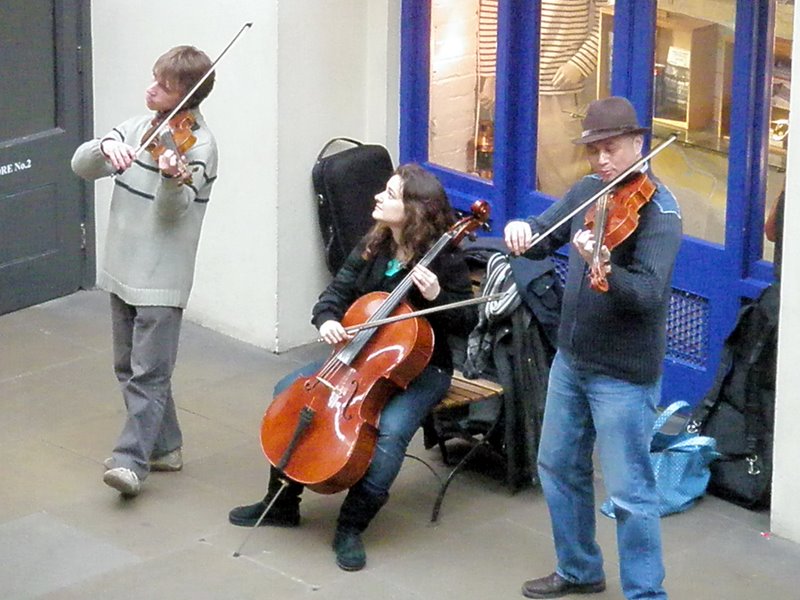
Last night I had decided to take in the matinee of War Horse, a play which has had rave reviews.  After much wandering around, I finally got to the theatre where the matinee was scheduled only to be greeted by a sign telling me that the performance had been cancelled.  Feeling somewhat at loose ends, I strolled over to Covent Garden and enjoyed the buskers who were preforming there. 

Buskers at Covent Garden
St Paul's

A quick look at St Paul's, Covent Garden, in front of which George Bernard Shaw's Eliza Doolittle sold her flowers and a walk back to the National Portrait Gallery.  There I spent some time looking at the pictures of 19th Century notables.  All very interesting.  One of the most fascinating subjects of a portrait was Frederick Gustavus Burnaby. 

Frederick Gustavus Burnaby

It may be Burnaby's death in hand-to-hand combat at  Abu Klea to which Sir Henry Newbolt is referring in his poem Vitai Lampada.

The sand of the desert is sodden red, --
Red with the wreck of a square that broke; --
The Gatling's jammed and the colonel dead,
And the regiment blind with dust and smoke.
The river of death has brimmed his banks,
And England's far, and Honour a name,
But the voice of schoolboy rallies the ranks,
"Play up! play up! and play the game!"
 On the bus and back to Marble Arch.  Speaking of the buses, it is rare to see one of the older style double deckers.  They are all now sleek and shiny and fully enclosed.  Occasionally, however, one of the older models can be spotted and they seem to have been relegated to one particular route.  Here is one of the Number 9 line buses with the half front and the open back.

An old style Number 9 bus


Back at Marble Arch I spent a few minutes admiring both the arch itself and the six tonne bronze horse's head sculpture next to it before getting a bus back to the hotel. Historically, only members of the royal family and the King's Troop, Royal Horse Artillery, have been allowed to pass through the arch in ceremonial procession.

Marble Arch
Horse Head Sculpture

Wednesday, March 9, 2011

London, Day 3

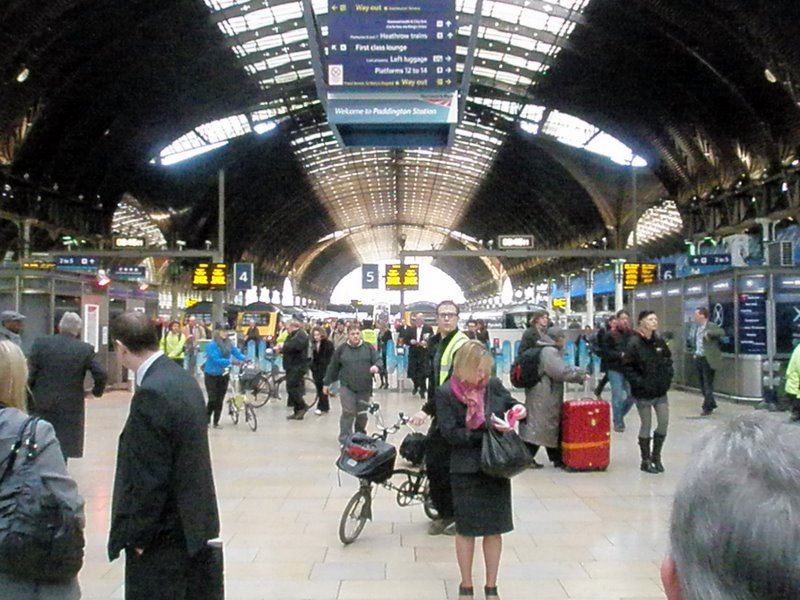
Paddington Station
 
Wednesday - a quiet day.  Virginia headed off to Bath Spa to catch up with an old friend and I decided to take myself to the West End to see a show.  The trip to Bath Spa, for Virginia, meant going down by train on the Great Western which departs from Paddington Station.  Of course, the most famous bear in the world is associated with this station and it would be remiss of Great Western were there not some image of Paddington Bear so,  there is a statue of the charming little creature at the station.

Paddington Bear

Since we arrived at the station well before Virginia's scheduled departure, we had a chance to wander around this historic site which has served as the London terminus of the Great Western Railway and its successors since 1838. Much of the current mainline station dates from 1854, and was designed by Isambard Kingdom Brunel. So, in addition to the statue of Paddington Bear, there is a statue of Brunel.

Isambard Kingdom Brunel
At the moment there is a great deal of work going on in London because of the 2012 Olympics.  Obviously the city is going to be on show and there are lots of souvenir shops opening up with all sorts of kitsch goods on sale. There is, of course, an official shop which can be found at various locations in the city and one of these is at Paddington Station.  The official mascot is an odd looking, one-eyed creature named Wenlock, while the official paralympics mascot is Mandeville. 

Wenlock and Mandeville
The Olympic Shop in Paddington Station
Once Virginia was on her way I hopped on the tube and went to Victoria Station and the Apollo Victoria Theatre.  The last time I was in that theatre was way back in 1985 when I went there to see Andrew Lloyd Weber's "Starlight Express."  It now is the home of "Wicked," a great musical about the witches in The Wizard of Oz.

The Apollo Victoria Theatre
I must say I thoroughly enjoyed the show and recommend it highly.  It has played, I believe, in both Melbourne and Sydney and I know it is scheduled to have a run in Adelaide.  It really is "not to be missed."

After the show I caught the tube at Victoria Station and met Virginia at Paddington Station.  A pleasant drink at a local pub ended the day for us.

Victoria Station

Tuesday, March 8, 2011

London, Day 2

Brick Lane in Spitalfields

Today we set out to visit Spitalfields in the East End.  The area straddles Commercial Street and is home to many markets, including the historic Old Spitalfields Market, founded in the 17th century, Sunday UpMarket, and the various other Brick Lane Markets on Brick Lane and Cheshire Street.

View over a Spitalfields Alley


Spitalfields has an historic association with the silk industry.  From about 1685 onward Huguenots settled here to ply their trade.  In the 17th and 18th centuries, the master weavers built terrace houses.  During the reign of Queen Anne, the elegant Christ Church was erected.

Christ Church


By the Victorian era, with the decline in the silk industry, many of the dwellings became slums with rooms housing 20 to 30 people with totally inadequate sanitation and no running water.   the silk industry had entered a long decline and the old merchant dwellings had degenerated into multi-occupied slums. New trades such as furniture and boot making came to the area; and the large windowed Huguenot houses were found suitable for tailoring, attracting a new population of poor Jewish refugees, escaping from the shtetls of Eastern Europe were drawn to live and work in the textile industry.

Nearing the end of the 19th century, Spitalfields had become one of the worst areas in the Metropolis. Criminals and prostitutes were to be found at every corner of the overcrowded streets.

Today there are two Spitalfields.  One is the crowded centre for Bangledeshi life, alive with the street markets and the wonderful smells of the restaurants.  The other is that of the upmarket, refurbished buildings that are gradually bringing a new middle-class population to the area.

A Spitalfields Street

A walk down Brick Lane quickly takes you back in time to the nineteenth century.  The crowded streets, the hustle and bustle, the "Beigal" shop considered by many to be the best Jewish restaurant and delicatessen in London are all there.  It is an exciting and vibrant area and one not to be missed.

From Spitalfields we caught a bus to the legal district where we planned to have lunch at the George pub.  This is one of the "institutions" of the area.  Just across the street from the Royal Courtts of Justice,courts, solicitors and barristers used to wait in the upstairs area looking across the street to the courts where, when a verdict was handed down, someone would signal across so the lawyers could return.  Today such traditions have probably gone by the boards with the pernicious influence of the mobile phone.

The Courts from upstairs at The George
Another institution of the area which whilst not gone would hardly be recognisable except for its frontage is the old Wig and Pen Club.  Closed in 2003, it was the last lawyers' and journalists' drinking den.  Here, it is rumoured the headless ghost of Oliver Cromwell wandered around the pub in its better days.  It is said that the building was the only structure in the Strand to survive the great fire of London in 1666. Today it is a Thai restaurant.  Oh how the mighty have fallen!  Well, not all of the mighty.  Starting out as Tom's Coffee House, and purchased by Thomas Twining in 1706, the Twining's Tea Shop remains.

The stained glass window at the Wig and Pen


The area is on the border between "The City" of London and Westminster. The boundaries of the City are marked by black bollards bearing the City's emblem, and at major entrances, such as at Temple Bar on Fleet Street, a grander monument, with a dragon facing outwards, marks the boundary. From the Royal Courts of Justice we walked through the quiet and very lovely area of Middle Temple.

Boundry Marker for the City of London

Middle Temple is one of the four Inns of Court which has the exclusive right to Call men and women to the Bar. The Inn is comprised of Student, Barrister and Bench Members and is governed by the Masters of the Bench.

Buildings in Middle Temple

A walk through Middle Temple takes one to the Embankment and after a gentle stroll and a look across the Thames we moved on to the statue of  Isambard Kingdom Brunel, the greatest of the nineteenth century engineers.

View over the Thames from the Embankment
Isambard Kingdom Brunel

We cut through the Savoy.  It has been refurbished and is a magnificent Art Deco structure.  Then onto a bus and back to our hotel.

The Savoy Hotel and Theatre

Monday, March 7, 2011

London, Day 1


After a marathon night's sleep, we were up and ready to go.  Inevitably, when one arrives in a new location after several days of travel, there are a number of tasks with which one is faced.  In this case it was getting our laundry up to date and dropping dry cleaning in. We completed these tasks by 9:30 after a very nice breakfast.  In case we hadn't mentioned it the hotel includes a very good continental buffet breakfast with meats, cheeses, cereals, bread, rolls, croissants, etc.

The next items on the agenda were to get our Oyster Cards ready for use and to pick up tickets for Virginia to go down to Bath for a day. On the way to Paddington Station, we passed some of the beautiful eighteenth and nineteenth century row houses in the area.  Sadly they are now hotels in most cases, but their facades remain a sight to see.

Beautiful old buildings near Paddington Station

For those not familiar with the Oyster Card, it is similar to cards used in most big cities these days.  You pay for a specific plan (in our case for a week) and then can use the card as often as you wish within the designated period..  What is good about it is the cost on a weekly basis is about equivalent to two daily one way trips on public transport.  As a result, it offers a significant saving for us since we do a lot of travel by bus and on the tube.  Virginia's ticket to Bath was purchased and paid for ages ago from Hobart and to pick it up all that was required was to insert the credit card used at the time into a machine (for identification purposes) and type in the ticket number which was sent to us by email and, voila, out came all the necessary tickets.  How easy is that?

Picking up pre-paid tickets

Next it was time for some basic shopping.  For this we walked up to Queensway. The top end of Queensway is dominated by the huge Whiteley's shopping centre where many of the familiar high street names can be found, together with a choice of restaurants and a multi-screen cinema.Whiteley's was London's first department store and one of the most luxurious.  As a shopping centre, it is considered by many to be the most elegant in London.  The founder of the department store, William Whiteley, was murdered in 1907 by a man claiming to be his illegitimate son. There's nothing to spice up shopping like a little bit of scandal.  Anyway,we went to Marks and Spencer in the Whiteley's centre, and across the street to Boots where we finished our shopping.

Whiteley's

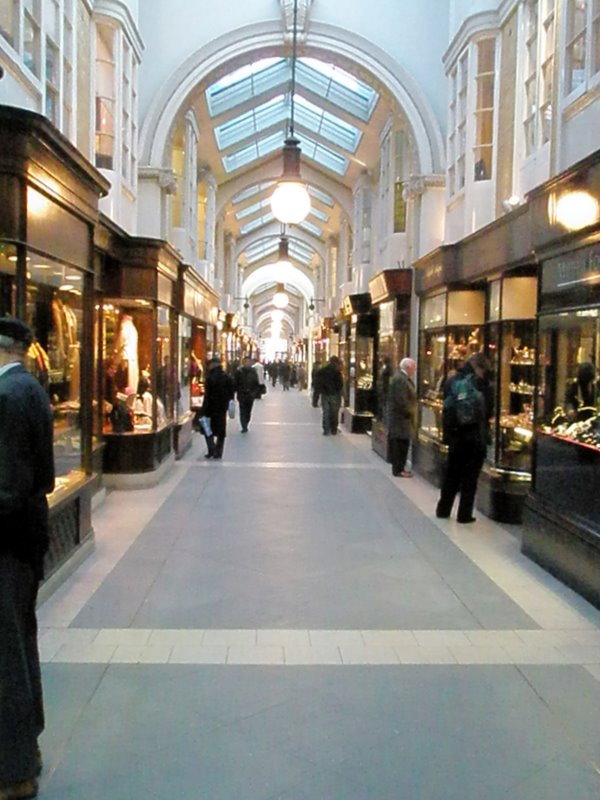
In the afternoon we we went to the Burlington Arcade.  Virginia wanted a pair of gloves and had noticed a very elegant glove shop when we were last in London.  The shop, Sermoneta, has more gloves than one can imagine.  I mean, after all, how much variety can there possibly be in gloves?  Well, let me tell you, gloves come in every colour and every combination of colours.  They come lined and unlined.  They come in all lengths and with all sorts of trimmings.  And that is just the women's gloves.  They have a full range of men's gloves as well!

Burlington Arcade

Once the new gloves had been acquired we headed for Fortnum and Mason's to refresh ourselves with a pot of tea after such an exhausting process. 

Tea?

Unfortunately we were unable to have tea there (even though Virginia had elegant new gloves) but we did have an interesting wander around.  Did you know that there are hundreds of blends of tea and Fortnum and Mason's appears to sell most of them and has been doing so for almost 300 years?

Heart shaped sugar
We were fascinated by the sugars for sale there.  They have brown sugar, white sugar, black sugar, heart shaped red sugar, sugar with the F&M logo, sugar shaped like butterflies and even more.  Amazing.  And since it is so close to Easter ( only 48 more days) all of the Easter goodies were on display as well.  Certainly they do a wonderful job of displaying their goods.  

 After having a cup of tea nearby we headed for Piccadilly Circus to catch a bus to take us back to the hotel.  On the way, we passed the beautiful Christopher Wren designed St James Church (1684).

St James Church, Piccadilly

From there we continued to walk until we got to Regent Street where we boarded a 23 bus to take us back to Paddington and to our hotel where we organised ourselves for dinner and concluded our first full day in London.

Regent Street

Sunday, March 6, 2011

Airport Thoughts

For us to get to London from Hobart required passing through four airports: Hobart, Melbourne, Singapore and London Heathrow. They are all different, one from another, and vary dramatically in their creature comforts and speed of processing.

Let's start with Hobart.  It is a small airport for a city of around 212,000 people.  It was upgraded a few years ago and much improved at the time.  Since then, however, the private corporation which runs it has done little to keep it up.  Frankly, it is dirty and crowded.  Security check-in consists of two gates one of which, in our experience, has never been open.  No, that is not true.  While the queue for one was well over 100 meters in length, the other gate was opened just long enough to let some commercial goods be checked through so the poor benighted passengers, when they finally made it through the queue, could get over-priced sandwiches.

Melbourne was an improvement.  The airport is being upgraded and has always maintained a reasonable standard. After passing through immigration the upgrading has meant a greater variety of shops and more comfortable seating whilst waiting.  A whole new area has been added to accommodate the hundreds of passengers departing on the A380s.

Then, of course, there is Singapore.  There are not enough superlatives in the English language to describe the airport.  It is quiet, spacious and full of the best shops from around the world.  It has a transit hotel in which you can stay while your bags go on to your destination.  If however you are staying for a few days in the city, you can clear immigration and customs in no time at all.  Hundreds of flights arrive and depart daily yet there is a sense of peace  and  of being welcome. At all times it remains impressively efficient and scrupulously clean.
One of many dining areas in Singapore Airport
A rest area at Singapore Airport
Statuary in the Arrival Hall
One of many shops at the Singapore Airport

After fourteen hours in the air, we arrived at London Heathrow.  The plane landed and then began taxiing to a gate.  We taxied and taxied and then taxied some more.  Part of the reason may be that we were in an A380 which is the largest commercial passenger plane in service.  It can hold 800 passengers although the Singapore Airlines configure them for around 500. While we were going to our arrival gate we felt as if the pilot had to find an available one and it was a bit like looking for parking at a major shopping centre on Christmas Eve!

God knows that after fourteen hours cramped, strapped in and immobilized in economy class one needs substantial exercise to overcome the threat of DVT.  Well, Heathrow provides it!  Just walking from the arrival gate to border security must be at least two kilometers.  And not just any two kilometers.  These are weight bearing kilometers because Heathrow seems to have only two luggage trolleys for all 500 passengers.  But, on the other hand, after wandering through the barren, cold and unwelcoming corridors, one can look forward to the joys of unacceptably long waits at border security.

Virginia relishes this.  She has a European Union passport and knows that she will go through the line labelled "British and EU citizens" while my line, labelled "all others" should probably have a sign, "abandon hope all ye who enter here."  I remind myself that I have to be kind to Virginia as she can take me with her through the shorter line although I must say I feel a bit like a piece of luggage as she anounces "this is mine, can it come through with me, please."

On a more serious note, however, if your spouse or partner has an EU passport, and you do not, you can, in the UK, accompany them through the shorter line. This may not be the same in other EU countries.

In fact, Border Security check points were adequately staffed on this occasion, something we had not experienced before.  We wondered if this was because the system had been restructured to cope with the larger number of passengers arriving all at once on the A380s.

Well, we are in London now and won't have to think about airports for several months as our travel into and around Europe will be by train. The first train trip, of course, is on the Heathrow Express from the airport to Paddington Station which is only a five minute walk from where we are staying.  A walk to the hotel, unpacking and to bed.  Our "vacation" starts tomorrow.

Our hotel., the Lancaster Hall Hotel which is the German YMCA

Thursday, March 3, 2011

Departure Evening

Tomorrow we are on our way and in a few days we will be in London.  It's quite cold in Hobart and will be even colder tomorrow but the weather here is as nothing compared to London and Paris at the moment.

I've just checked the temperature and general outlook in London for our arrival is about six degrees Celsius and our first night there it will be down to zero or minus one. To think that a day or two ago I was debating whether to take an overcoat or not.

The overall flight time is about 20-22 hours but we spread it out over several days.  Tomorrow we will spend the night in Melbourne and catch a mid-day flight to Singapore where we will spend Saturday night.  A mid-day flight again will take us on to London.  One of the nice things about the trip is that we will be on the A380 from Melbourne and again from Singapore.  It is a wonderful plane and we have seats on the upper deck.  That means we are in two seats between the window and the aisle!  No stepping over sleeping strangers.  It is also a very quiet plane and I am hoping to catch up on some of the movies I missed this year.

It is interesting to look at the documents that Virginia is transcribing as part of her work for the Historical Records of Australia project.  Sydney was all agog in 1852 with the news that Steamships would knock a couple of weeks off the seventeen week trip from London to the colonies.  And we complain about a trip that can be made in less than 24 hours.

I suppose I'd better get back to packing. It is finally dawning on me that we really are going tomorrow.  The cab is ordered and I've just checked us in on-line.  So, until next time . . .